

Navigate
Products
Download
eShop
Upgrade
Overview
Training
Support


Navigate
Products
Download
eShop
Upgrade
About
Training
Support


When working in standard vectorization mode, new nodes can typically only be added sequentially after the final node on an edge. While you can use the Insert command from the context menu to add nodes elsewhere, this process can be inefficient when working with multiple points. Additionally, placing a new node in close proximity to an existing one can inadvertently trigger a node selection rather than creating a new point. The Insert Elements mode is designed to resolve these issues with two primary advantages:
To activate Insert Elements mode using a keyboard, press and hold the "a" key while clicking the primary mouse button at the desired location within the Work Area.
For devices without a keyboard, navigate to Menu (create/edit mode) > Edit > Insert, or use the Element Mode button on the menu bar to activate this feature.
Inserting new nodes is particularly useful when refining automatically generated connections between objects or when digitizing complex shading effects using manual stitches. When creating a high volume of manual stitches, this mode prevents the accidental selection of existing nodes, streamlining the digitizing workflow.
The following example illustrates the insertion of new nodes. In this scenario, the polyline ends at point (E), but we need to insert several nodes following node (2). Begin by clicking to select node (2).
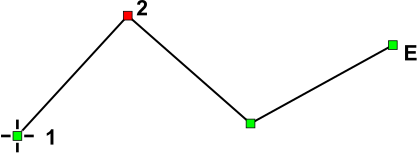
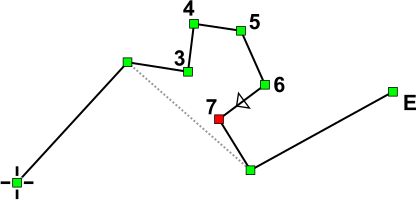
Activate Insert Elements mode and click where you wish to place the additional points. Create the new nodes (3), (4), (5), (6), and (7). Once finished, exit Insert Elements mode. Note that these points are now integrated into the middle of the node sequence immediately following node (2). The dotted line in the image below represents the original path of the polyline.
Note: While Insert Elements mode is active, existing nodes cannot be selected or moved. To regain selection capabilities, you must first exit the mode by releasing the "a" key or deselecting the option in the menu.