

Navigate
Products
Download
eShop
Upgrade
Overview
Training
Support


Navigate
Products
Download
eShop
Upgrade
About
Training
Support


This tool is accessible via Main Menu > Objects > Color while in selection / transformation mode.
Color tuning allows you to shift the overall coloring scheme of selected objects quickly and uniformly. This is especially useful when creating detailed or realistic designs, such as portraits, animals, florals, or landscapes. Instead of manually adjusting dozens of individual thread colors, you can move the entire selection toward a colder or warmer tone, brighten or darken the composition, or make the colors more vivid or dull. This ensures a harmonious result while significantly reducing the time required for color experimentation.
The Tune Colors command opens a dialog window containing Brightness, Contrast, Gamma, Saturation, and Color Balance controls (Cyan-Red, Magenta-Green, Yellow-Blue). These settings modify the color of vector objects and their corresponding stitches (thread), rather than the colors of the underlying raster image.
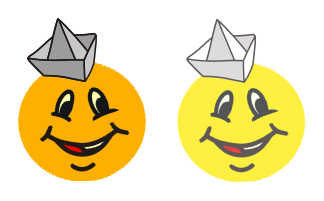
Left: original colors before tuning. Right: brightness increased for all objects at once.
Adjusting colors using the Yellow-Blue, Red-Green, and Cyan-Magenta balance tools involves modifying the proportion of these complementary color pairs within your design.
Understanding how these color pairs influence one another is essential for achieving specific aesthetic results.



These balance adjustments can be applied independently to Shadows, Midtones, and Highlights for precise control. Rather than affecting the entire design uniformly, you can fine-tune colors in the darkest regions (shadows), the middle tonal range, and the brightest areas (highlights) to achieve a more refined color correction.
Sfumato Color Tuning: The Tune Colors function applies to individual shades within Sfumato objects as well as to the base color. This facilitates precise adjustments for portrait work.