

Navigate
Products
Download
eShop
Upgrade
Overview
Training
Support


Navigate
Products
Download
eShop
Upgrade
About
Training
Support


This is a sub-chapter of the Mesh Parameters chapter.
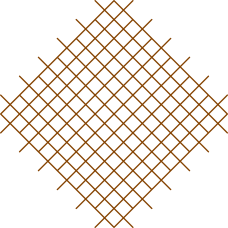
Cross-stitch is a popular and straightforward technique in counted-thread embroidery. Its defining characteristic is the use of distinct X-shaped stitches to construct a design.
This page details the Crosses parameters available within the Mesh tool of Embird Studio NEXT. This guide explains how to generate cross-stitch style fills by selecting cross types, adjusting stitch dimensions, and controlling the fill span relative to object boundaries. Additionally, it covers aligning crosses to a common grid for pattern consistency and optimizing stitch density through the merging of collinear half lines.
Kind - Specifies the type of cross used for the mesh fill.
Size - Defines the dimensions of individual crosses. All crosses within an object maintain uniform sizing unless modified by an effect or transformation.
Span - Determines the extent of the cross fill relative to the object contours. Available options include Overflow, Cropped, and Interior. When using the Overflow setting, object contours can be excluded from the mesh via the Common Settings tab.
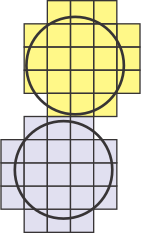
Align to Common Grid - This option allows crosses in separate objects to align to a unified global grid. For this alignment to function correctly, the objects must share the same cross size, and no effects or transformations should be applied.
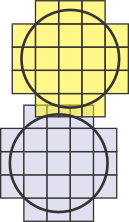
No alignment
Aligned to common grid
The Align to Common Grid setting is essential for maintaining pattern continuity across a design composed of multiple separate objects. Without this setting, each object generates its fill based on its own internal coordinates, which often leads to mismatched patterns where objects meet.
The Problem: Fragmented Patterns
When digitizing a large Celtic knot or cross-stitch area using several smaller vector shapes, the software naturally treats each shape as an independent container:
The Solution: Global Coordinate Synchronization
By enabling Align to Common Grid, you instruct the software to ignore individual object boundaries as the "zero point" for the pattern. Instead, the software utilizes a global coordinate system relative to the design hoop to calculate the pattern layout.
Requirements for Successful Alignment
For the alignment to function correctly, the objects must share identical geometric properties. The grid synchronization will fail if any of the following parameters differ:
Workflow Tip: To ensure consistency, select all objects that should share a pattern and apply the Align to Common Grid setting simultaneously in the Parameters dialog. If you need to shift the entire unified pattern, use the Offset parameters within the Transformations tab.
Merge Half Lines - Crosses are constructed from half lines that intersect at the center. Collinear half lines can be merged to reduce the overall stitch count. Note that while this optimization improves efficiency, it may subtly alter the uniform texture of the finished embroidery.


Separate half stitches
Merged half stitches
Please note that the Crosses fill within the Mesh tool is intended for decorative fills within vector objects and does not replace the specialized Embird Cross Stitch module. While the Mesh tool provides a convenient way to add cross-stitch textures to any shape, the dedicated module offers more advanced features specifically for traditional counted cross-stitch design, such as full-chart management and specialized backstitching capabilities.