

Navigate
Products
Download
eShop
Upgrade
Overview
Training
Support


Navigate
Products
Download
eShop
Upgrade
About
Training
Support


Embird Studio NEXT supports the integration of several motifs within a single fill object. These multiple motifs can be customized using various parameters, including scale, shift, angle, wave, and gradient. The software automatically handles motif sizing to ensure seamless integration. This technique enables the creation of complex, unique, and even randomized fill patterns.
To utilize this feature, initiate a fill object, access its parameters, and select Motif mode. Once in this mode, navigate to the table tab.
Multiple motifs can be combined with all standard single-motif options, such as scale, shift, fill angle, wave, and gradient. While the selected motifs must maintain uniform dimensions, the user is not required to manage this manually; the software automatically resizes chosen motifs to match the "master" motif. The master motif is the one selected on the Main Settings page and is displayed in the top-left cell of the motif table.
The tab for the multiple motifs table is only visible when Motif mode is active within the fill parameters window.
Use the Rows and Columns controls to define the motif layout. The software allows for a table configuration of up to 3x3 motifs.
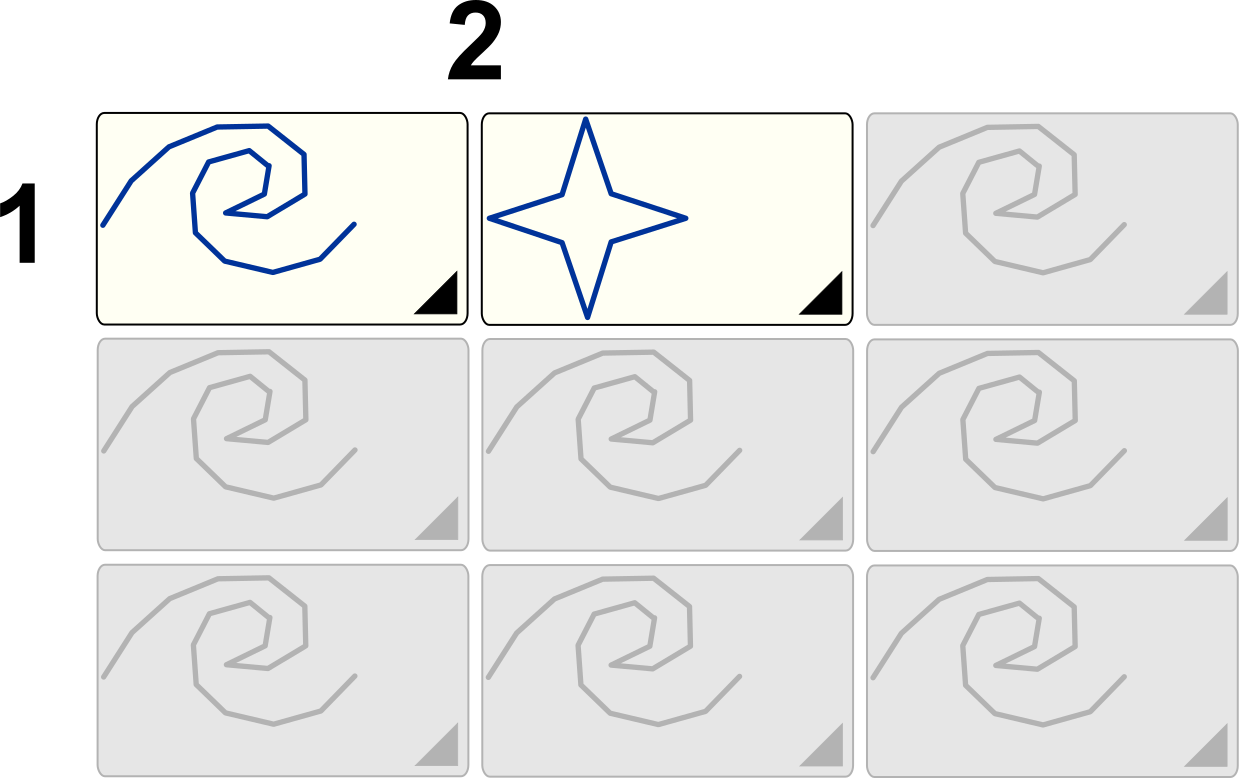
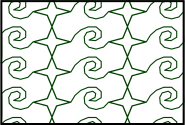
A 2x1 table configuration featuring two distinct motifs.
Implementation of two motifs within the same embroidery object.
By defining the number of rows and columns, you establish the specific grid used to populate the object. You may select either predefined or user-defined motifs for the individual cells within the table. After configuring the grid, click the , , or button to commit the new settings to the object.
In Embird Studio, both Motif Fill and Mesh Fill are utilized to cover expansive areas with decorative patterns; however, they differ significantly in their geometric structure and stitch layering.
The Motif Fill operates similarly to wallpaper. This method repeats a small, pre-digitized embroidery element - known as the motif - in a structured arrangement of rows and columns across the interior of a vector object. It is a systematic approach to filling a space with consistent, repeating units. Motif Fill utilizes precise, small, pre-digitized stitch samples to ensure uniform texture.
The Mesh Fill represents a more modern and flexible approach to digitizing. Rather than relying on simple repetition, the filling stitches are distributed using various space-filling geometric and organic algorithms. These can include fractal patterns, plant growth simulations, or the "packing" of letters and secondary shapes to populate the area of the object. This method allows for a more dynamic and less uniform aesthetic compared to traditional motif fills. Mesh Fill generates curved paths upon which stitches are calculated dynamically.
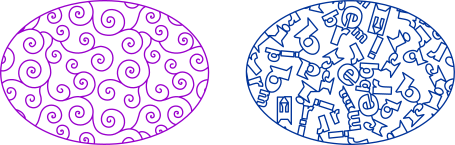
The Mesh fill - more dynamic than the Motif fill